
Kanting qualia
Putting “phenomena” back into phenomenal properties

In his recent blog post, and in the excellent paper “Qualia Quietism”, Pete Mandik argues that the debate between phenomenal realism and illusionism is fundamentally misguided. Why? Because it’s not clear what phenomenal properties are even supposed to be. And if we can’t say what they are, then it’s equally unclear what illusionism is supposed to deny. Here's a bit of what Mandik writes:
The term “phenomenal,” as used in contemporary philosophy of mind, is a technical term. I am aware of no non-technical English word or phrase that is accepted as its direct analog […] Common practice in philosophy of mind treats “phenomenal” as interchangeable with, for instance, “qualitative” or, in scare-quotes, “‘feely’”. [...]
We have, in place of an explicit definition of “phenomenal properties,” a circular chain of interchangeable technical terms […] I’m skeptical that any properties seem “phenomenal” to anyone because this vicious circle gives me very little idea what seeming “phenomenal” would be.
I highly recommend checking out both his post and the paper.

Now, I’m broadly sympathetic to the quietist view. But I think we can say a little more about what phenomenal properties should be, and embrace them as concrete citizens of the actual world.
A brief history of phenomenal properties
It all starts with Descartes’ skepticism. If we can be radically deceived by the way the world really is, then how can we have any knowledge about the world? This was the moment where the world as it is in itself and the world as we experience it started to come apart. Descartes unpacks this further by attempting to put his finger on what we can know about external (non-mental) objects.
[W]e know nothing of external objects beyond their figure [or situation], magnitude, and motion… all the other sensible qualities… we apprehend only as dispositions of those objects to move our nerves in a variety of ways, by which they excite in us sensations.
—Descartes, Principles of Philosophy
Locke builds on this with his discussion of primary qualities (like extension and motion) and secondary qualities (like color and taste). Locke thinks the former exist in the object and cause ideas in us that resemble them, whereas the latter exist only as powers of objects to produce sensations in us, but these sensations don’t resemble anything in the object.
For me, this is where the so-called “hard problem” (if there is one) gets its foot in the door. If the world as represented to us is categorically different from the world in itself, how does one produce or explain the other?
Enter Kant
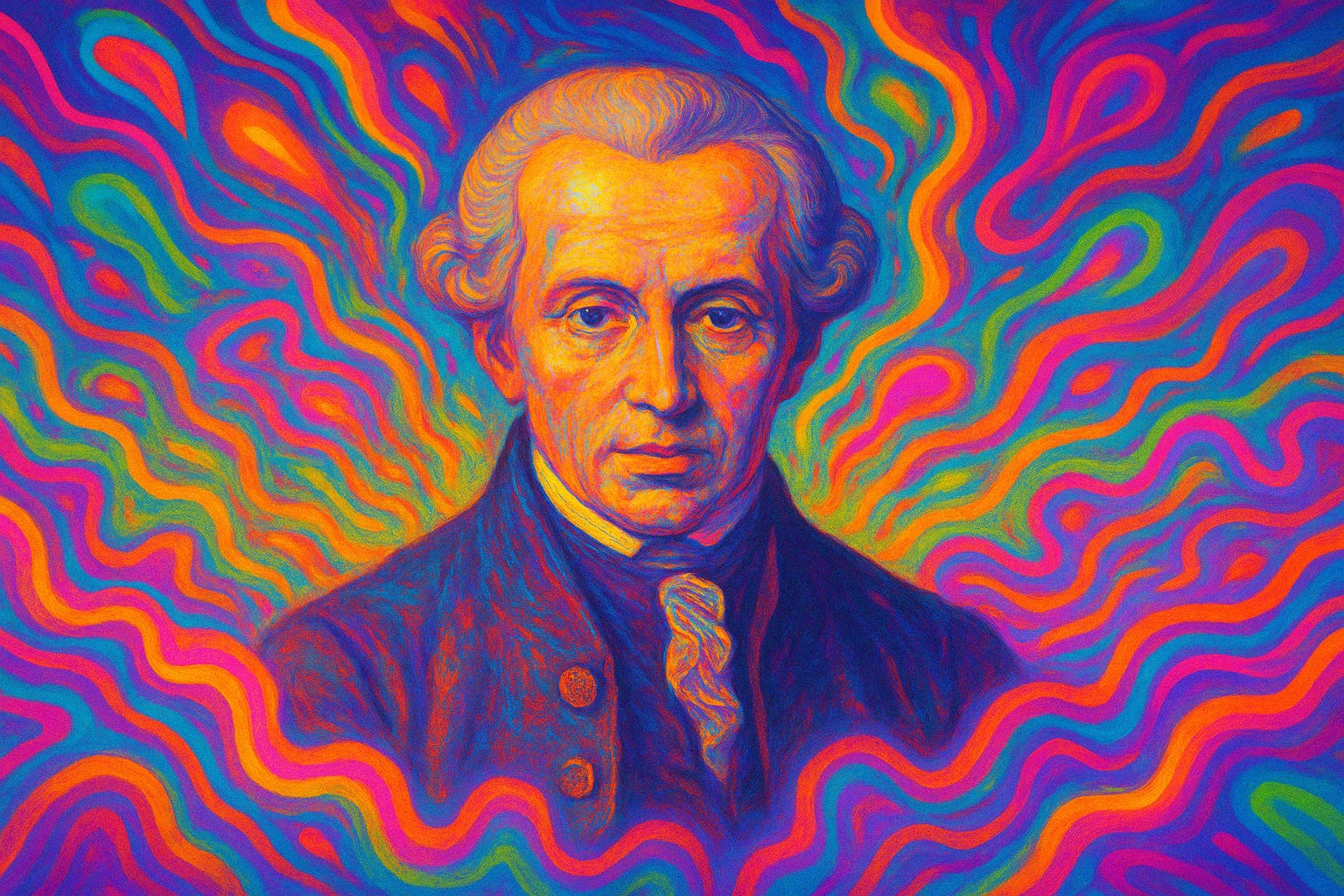
Then Kant comes on the scene with his distinction between phenomena (things as they appear to us) and noumena (things as they are in themselves). Kant tells us that the noumenal is essentially off limits—that we can only speculate about how things are aside from our experience, since even space and time as we experience them are phenomenal, not noumenal. For the space that I perceive is by definition space as it appears to me, that is, phenomenal space! What space is like when I’m not experiencing it is never something I experience, nor can I (necessarily!). We don’t see past phenomenal space to some space-as-it-is-in-itself; even if that something (though, I know not what!) ultimately drives or underpins the phenomenal realm. So for Kant, sure, there might be a noumenal realm, but we can’t say anything conclusive about it.
It must be stressed that Kant diverges from Descartes in an important way. Descartes thinks that we have access to real, mind-independent properties like size and shape, and that our minds create some additional mental properties such as colour, taste and smell that we project back onto the world, even though they are not really out there.
Kant rejects this picture. For Kant, the shape and size of a rose are both as phenomenal as its redness (to use the paradigm example of a phenomenal property). This is because the shape and size of the rose as experienced are not noumenal shapes and sizes (as they exist independently of experience). Rather, they are shape and size as experienced by an experiencer.
This is Kant’s rejection of the cartesian divide between mind and matter. What Descartes would call material turns out to be experiential for Kant. So even the material world we experience is experience-invoking; the world of our experience isn’t independent of our experience.
From Kant to Phenomenology
From here, you can see how phenomenology gets off the ground; a method that seeks to understand our experiences and the way the world is given in experience.
What it is like
Fast Forward to the introduction of the terms “Qualia” by C I Lewis (1929), and the phrase “what it is like” by Nagel (1974). I take it that Lewis and Nagel were simply reintroducing some experiential terms into the analytic tradition. I suggest that there is a rough mapping (perhaps even an equivalence) between Kantian expressions like “the way this object appears to me” to the Nagelian “what it is like for me to perceive this object”. It's not about sprinkling some magic fairy dust onto an ordinary experience, it's about distinguishing the way things appear to me from the way things appear to you, and distinguishing appearances in general from however things are aside from appearances.
Phenomenal consciousness
Then Ned Block (1995) introduces his distinction between “phenomenal consciousness” and “access consciousness”. While I think Block’s distinction is theoretically interesting, it has the unfortunate consequences for some that phenomenal consciousness is whatever is left after access consciousness is set aside. Many conclude that there is nothing left, so phenomenal consciousness can be eliminated! While this is certainly one way to go, I think a more fruitful direction would be to take heed of Block when he says:
Perhaps P‑consciousness and A‑consciousness amount to much the same thing empirically even though they differ conceptually, in which case P‑consciousness would also have the aforementioned function. Perhaps the two are so intertwined that there is no empirical sense to the idea of one without the other.
—Block, On a confusion about a function of consciousness
In sum, we should try to identify phenomenal consciousness, not eliminate it!
Characterising phenomenal properties
Okay, so with this backdrop in place, what are phenomenal properties? In roughly Kantian terms, they are properties of the world as it appears to us. With a more contemporary spin, they are properties of the world as represented by us. In phenomenological terms, they are properties of the world as lived by us.
Is this any better than the circular set of technical terms that Mandik warns us of? I can imagine someone trying to leverage similar worries, but I think this would be a mistake. Kantian phenomenal properties are designed to be contrastive. Your phenomenal properties aren't to do with how you are perceived or experienced by someone else. They are properties of the world as they seem from your perspective. And more importantly, phenomenal properties in general are not properties of things as they are independently of anyone’s (possible) experiences.
Relaxing privacy
The way the world seems from your perspective is different to the way the world seems from my perspective. But this is to be expected, because we have different vantage points, belief systems and cognitive apparatus. It’s not impossible in principle for someone to have a phenomenally identical experience to me. It’s just extremely unlikely that someone would share all the features that shape my particular experiences. The only way to experience the world as I do is to be me, or to have sufficiently similar capacities and memories. This is all privacy amounts to for Kantian phenomenal realism.
Unlike the circular definitions of “phenomenal” in contemporary philosophy of mind, Kant introduces the term as a distinction and contrasts it with whatever exists beyond our experience.
Notice that on this reading, phenomenal properties needn’t have any of those heavy-weight features that some phenomenal realists like to build in (ineffable, infallible, non-physical, non-functional, non-representational, intrinsic, etc.). Given that they are not necessarily any of those things, this kind of neutralises phenomenal properties, making them at least less problematic for physicalists.
[This obviously depends on what we say about the ultimate nature of physicality. Is it to be cashed out in terms of spatiality? If so, phenomenal or noumenal spatiality? Or is it to be unpacked in terms of fundamental non-mentality? There may or may not be a problem.]
In any case, phenomenality in this sense ought to be an innocent feature of any view.
Mandik’s challenge
People are all over the map with what they mean by "qualia." Some think that they are properties of mental states, especially experiences. Some think they are the experiences themselves. Some think they are the objects of experiences, the things experienced. And some muddle-heads don't really know what they think (surely YOU, dear reader, aren't one of THEM).
This is absolutely correct. But I think there is an explanation for this confusion. We don’t tend to confuse maps with their respective cities. Why? Because maps are opaque. We don’t see through a map to the city beyond. But experiences are transparent—we apprehend the world through them. As such, it’s sometimes hard to tell what is a property of the world and what is a property of an experience. So maybe phenomenal properties are “in here” or maybe they are “out there.” This seems to me to be a more reasonable question than whether the properties of appearances exist.
We can also turn our attention from what we are perceiving to the way we are perceiving it; from the yellow lemon to the lemon’s yellowness, or to the way we represent its yellowness. This can make it hard to see what has the properties in question.
All I’ll say is that phenomenal properties are properties of systems that involve an experiencer, an object of experience and a particular mode or way that the object is experienced.
K-zombies
What then is a Kant-style philosophical zombie (henceforth ‘K-zombie’)? Your K-zombie twin is a being that is noumenally identical to you (it is identical to you in all non-experiential, mind-independent respects) but doesn’t apprehend anything. Things don’t appear any way at all from their perspective. The yellowness of a lemon isn’t apprehended by your K-zombie twin. Neither is its shape, weight, size, texture, solidity, smell, taste. Nor is there any differentiation between the lemon and whatever is near the lemon. Your K-zombie twin can’t tell the difference between pain and pleasure, since they don’t even apprehend their own internal states. Their life goes on completely in the dark. In sum, Kantian zombies are fully-fledged philosophical zombies.
Notice that in denying your K-zombie twin appearances of the world and internal states, we have inadvertently killed off some of their functional capacities. If your zombie twin successfully distinguishes between a tomato and a potato, this must be by coincidence because there is nothing available or accessible to them with which to distinguish the difference. And if they happen to answer the question “do you prefer tomatoes or potatoes?” coherently, then this can only be by chance, because they have no internal means of representing the sounds that you have made to themselves in order to decode the meaning of those sounds.
So can a non-phenomenal duplicate of you exist that is functionally equivalent to you? No! K-zombies are impossible.
Illusionism about K-phenomenal properties
So what might an illusionist say about these kinds of properties? Should they say that phenomenal properties understood this way are a kind of cognitive illusion due to us taking our own experience too literally? This gets dangerously close to a contradiction. It sounds as if they’d be saying that “the world doesn’t appear to you the way that it appears to you”.
Typically, illusionists concede that experiences appear to have whichever tricky properties are supposed to cause a hard problem. But, they argue, you can be systematically wrong about how the world is (interestingly, the phenomena/noumena distinction already concedes this) and since you can be so radically wrong about the world, you shouldn’t put too much stock in how you think the world appears to you. That is also an illusion. Your experience isn’t really like that!
But Kantian phenomenal properties aren't loading in all those tricky (non-physical, non-functional, non-representational, ineffable, intrinsic, and so on) properties that illusionists claim are illusory and eliminativists want to eliminate. Those properties are further commitments over and above Kantian phenomenal properties. So illusionism about Kantian phenomenal properties might be incoherent after all and eliminativism about Kantian phenomenal properties says that the world doesn’t appear to you in any way at all!
Notice that this sounds like the kind of thing some of those heavy-weight phenomenal realists say about illusionism and eliminativism. But their inflated notion is precisely what creates logical space for eliminativists of any stripe to eliminate those inflated features without eliminating the whole lot.
In fact, I think some phenomenal realists are engaged in an equivocation fallacy. They argue for these inflated properties, then accuse their objectors of being incoherent for eliminating something more modest like Kantian phenomenal properties. It is the elimination of the latter that threatens the coherence of eliminative positions.
Objections to K-phenomenal properties?
Okay, so is it possible to reject Kantian phenomenal realism? Maybe! So how might that be done? Kantian phenomenal realism is committed to the idea that all knowledge that we have ultimately depends on our subjective experience. Empirical knowledge is founded on the mind's ability to grasp objects and entities represented in (phenomenal) space over (phenomenal) time. Rational knowledge is founded on our ability to perform cognitive functions over (phenomenal) time. To reject this picture implies that we can simply help ourselves to the noumenal realm, bypassing the phenomenal altogether. Let’s call this phenomenal-bypassing view Noumenal Physicalism. How might this view be epistemically justified?
Through experience? That depends on experiencers.
Through reason? That depends on reasoners.
Through science? That depends on constructing and testing theories, which in turn depends on those that can experience, reason and test.
So, short of a free pass directly to the noumenal world, this just collapses back into Kantian phenomenal realism. Even if noumenal physicalism is coherent, it’s going to be hard to justify it. It looks like it involves cutting off the epistemic branch you are sitting on.
The super-illusionist response:
We illusionists aren’t denying that the world appears to you in some way or other. We grant that. We're just saying the world doesn’t appear to you in the way you think it does. The appearance can come apart from your interpretation of that appearance. So we’re rejecting Kantian phenomenal properties as well as the more metaphysically loaded ones. To hold this view coherently, all we need to do is be externalists about… well, everything!—knowledge, justification, mental content, and the rest.
—Imaginary super-illusionist who sounds suspiciously like Dennett
Okay. This looks coherent on the face of it. But I guess I just don’t understand the motivation for this kind of view.
Here’s the view in a nutshell. We subjects do some work trying to speak about the way things are completely independently of how we experience them. So we construct a theory in which we chose to give more ontological weight to the non-experiential side. Then we remove the subjective side altogether, because it seems theoretically useless, and problematic given the stylistic preferences of the theory.
It seems as if the super-illusionist wants to forfeit their subjectivity and become a mere object. They've essentially eliminated subjectivity qua subjectivity, and to the extent they keep using the word “subjective,” they're just talking about some special case of objectivity.
But here’s a problem for hardcore externalist super-illusionist noumenal physicalism (HESINP). In order for illusionism to even get off the ground, there has to be an illusion. That is, there must be something that seems some way from someone’s perspective, even if incorrectly.
But doesn’t an illusion, by its very nature, require something internalist—a representation that you have cognitive access to without a neuroscientist telling you what your brain is doing? To count as an illusion, the system must be misled in a way that is accessible from the subject’s own cognitive point of view. But if mental and perceptual content is fully external, there is no internal point of view from which an illusion can be recognized as such.
Suppose the super-illusionist goes all-in and rejects internalism wholesale. Now the so-called “illusion” is just an external process—a functional or causal process in the brain with external content and justification. But if that's all it is, then what’s the illusion? There’s no internal content to go wrong. And how would a purely externalist being represent itself as having internal states? Does that even make sense?
A purely externalist being may well have false beliefs, but false beliefs are not illusions.
In short, an super-illusionism needs just enough internalism to generate an illusion, but not so much that it admits K-phenomenal properties. Drop internalism entirely, and the illusion dissolves—it becomes nothing more than an external process externally representing something external. So HESINP might be incoherent after all. Admit internal representations or appearances and you’re back with Kantian phenomenal properties.
Other wiggle-room?
Perhaps you could simply reject some of Kant’s conclusions to escape this puzzle. But even if you don’t go all the way with Kant, a phenomenon is just a fancy word for how something appears, which I take it no one really wants to reject. And it's incoherent to say that you can experience the world as it is completely independent of your experience.
Interestingly, the best free pass to the noumenal realm is to say either that the phenomenal realm exhausts the noumenal realm, or that the phenomenal realm is part of the noumenal realm. Neither of which reject the reality of Kantian phenomenal properties.
The take-away
Phenomenal properties exist and are so called because they are phenomenal—experienced from a given perspective. Rather than denying phenomenal properties because of some questionable things some phenomenal realists say, there should be dialectal room disagree about the nature of phenomenal properties without accepting all that tricky stuff or eliminating them completely.
After all, what intrisicality consists in, whether experiential properties are intrinsic, and whether there are any intrinsic properties at all are contentious questions. The respective conclusions one arrives at ought to be independent of the realism/anti-realism debate about phenomenal properties.
The same goes for characterising representational properties. Maybe A can represent B even if A is non-actual, but maybe A must be actual in order to represent anything at all.
The disagreement lies in these thorny metaphysical issues whose truths are far from obvious.
If you liked the content and tone of this article, consider sharing it—I’d be extremely thankful.
There’s no escaping from Kant, his whole system is set up as a genius ontological/epistemological trap. Kant famously ate qualia for breakfast, phenomena for lunch and philosophy of mind for dinner!
Hi Daniel. I’ve been challenging people like Dennett and Frankish too. I’m not sure if Kant will get you there in the end, but also consider my approach.
What do illusionists deny? I gained a good answer from Eric Schwitzgebel’s innocent/wonderful conception of consciousness, a paper written as a challenge to Keith Frankish. It taught me that they simply deny magical conceptions of consciousness, as in “ineffable”, “private”, and all the rest. So fine, I don’t believe in magical consciousness either (or magical anything). But here’s the thing. Illusionists do believe in one thing regarding consciousness that seems quite magical.
I began with Searle’s Chinese room. Don’t illusionists grasp the magic of saying that a room where Searle is using a rule book to assess Chinese input characters so that appropriate output characters can be created, will not “understand” Chinese? No? Maybe this is because “understanding” is a slippery term? We all understand thumb pain however, don’t we?
Here I observed that when my thumb gets whacked, associated information is neurally sent to my brain about the event. This should in some sense then be processed into new information, or the very thing that illusionists consider to mandate my thumb pain. Thus theoretically if there were marks on paper that were highly correlated with the information that my whacked thumb sends my brain, and it were scanned into a computer for algorithmic processing to print out paper with marks on it that highly correlate with my processed brain information, then something here should feel the very same thing I do when my thumb gets whacked! I consider this magical because in a causal world, information should only exist as such to the extent that it informs something causally appropriate. So my brain’s processed information should be informing something not yet determined which exists as me the experiencer of thumb pain.
If you check out my full post, first go directly to the AI podcast from Notebook LM. This was my first experiment with it, and I’m still blown away by how much better these “people” were able to say what I was trying to.
https://eborg760.substack.com/p/post-3-the-magic-of-computational